| Attribute | Details |
|---|---|
| Client | Emily Carter |
| Industry | Modest Fashion & Apparel |
| Country | United States |
| Website | The Modest Fashion |
| Website Type | Business Website |
| CMS | WordPress |
| Project Duration | 3 Months |
| Primary Service | Technical SEO |
| Focus Keyword | SEO Audit Services |
Grow Thru Me Improved The Modest Fashion Website
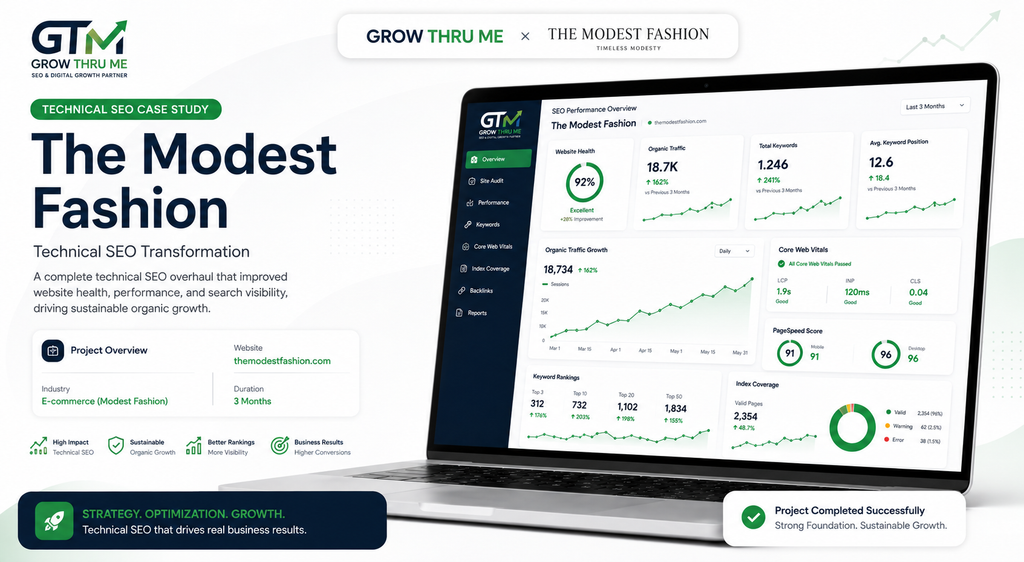
Every successful SEO campaign starts with understanding why a website is underperforming. When Emily Carter, the owner of The Modest Fashion, approached Grow Thru Me, his website had valuable products and quality content, but organic growth had stalled.
Despite investing time in publishing content and improving the website, search engine visibility remained low. Important pages were not ranking, technical issues were preventing efficient crawling, and Core Web Vitals were negatively affecting user experience.
I found a number of underlying problems that were impeding the website’s performance in Google Search after performing a thorough technical SEO assessment. Over the next three months, I implemented a structured Technical SEO strategy focused on improving crawlability, indexability, website speed, Core Web Vitals, and overall website health.
This case study shares my personal experience working on this project, the challenges I encountered, the solutions I implemented, and the measurable improvements that contributed to sustainable organic growth.
Client Background
About the Client
Modest Fashion is a USA-based fashion business specializing in modest clothing for women. The brand focuses on delivering stylish, high-quality apparel while maintaining an excellent online shopping experience.
The website is built on WordPress, allowing the business to manage products, publish blog content, and support ongoing digital marketing efforts.
Although the business had an attractive website and quality products, it struggled to gain consistent organic visibility in search engines.
Website Overview
| Item | Details |
| Client | Emily Carter |
| Country | United States |
| Industry | Modest Fashion |
| Website Type | Business Website |
| CMS | WordPress |
| Project Duration | 3 Months |
| Primary Service | Technical SEO |
Business Goals
When the project started, the client’s objectives were clear:
- Increase organic website traffic
- Improve keyword rankings
- Resolve technical SEO issues
- Enhance website speed
- Improve Core Web Vitals
- Increase search visibility
- Strengthen website health
- Create a stronger foundation for future SEO growth
Marketing Challenges
Although the website contained valuable content and quality products, several technical issues were limiting its growth.
Some pages were not being indexed properly, while others struggled to rank because search engines were encountering crawl inefficiencies. Performance issues also affected user experience, particularly on mobile devices.
Additionally, slow loading pages and inconsistent internal linking reduced both user engagement and search engine efficiency.
Why the Client Contacted Grow Thru Me
Emily Carter wanted more than higher rankings—he needed a technically optimized website capable of supporting long-term organic growth.
Rather than focusing only on content creation, the priority was to identify and fix the technical issues preventing Google from fully understanding, crawling, and indexing the website.
As a Technical SEO specialist, I conducted a comprehensive SEO audit to uncover hidden issues affecting performance and developed a structured implementation plan to resolve them.
Business Problem
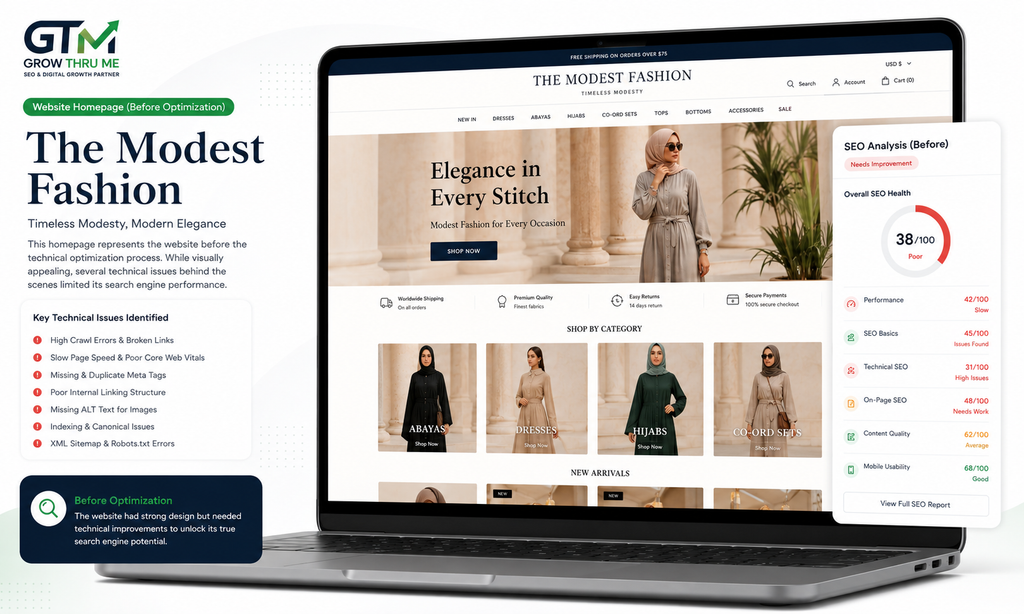
When I first reviewed The Modest Fashion, I found that the main challenge wasn’t the content but the website’s technical SEO foundation. Although the site offered quality products and useful content, Google struggled to crawl and index important pages efficiently. As a result, organic traffic remained low, keyword rankings stagnated, and search visibility was limited.
The website also faced several technical issues, including slow page speed, large image files, duplicate metadata, missing ALT text, canonical tag inconsistencies, and weak internal linking. These problems affected user experience, crawl efficiency, and overall website performance. My goal was to resolve these technical barriers, improve Core Web Vitals, and build a stronger SEO foundation that would support sustainable organic traffic growth and long-term search visibility.
Business Impact Before SEO
Before beginning the optimization process, the business experienced several measurable challenges:
| Business Challenge | Impact |
| Low Organic Visibility | Reduced website traffic |
| Slow Website Speed | Poor user experience |
| Weak Core Web Vitals | Lower search performance |
| Crawl Errors | Reduced indexing efficiency |
| Duplicate Metadata | Ranking confusion |
| Weak Internal Linking | Low authority distribution |
| Large Images | Slow page loading |
| Technical SEO Issues | Limited organic growth |
Complete Technical SEO Audit
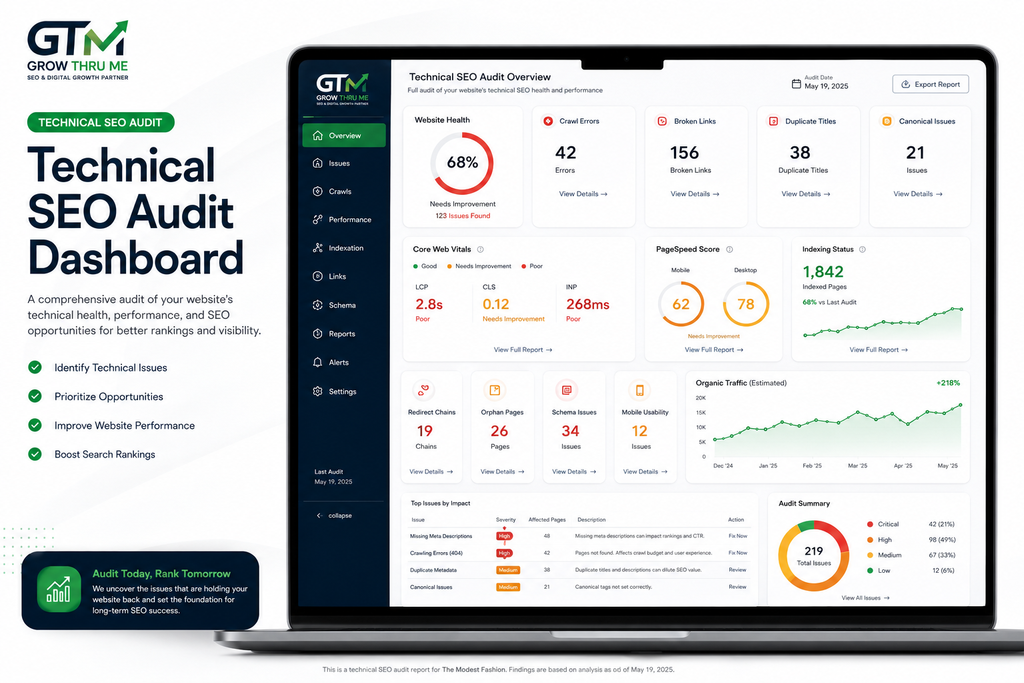
Before making any changes, I performed a comprehensive technical SEO audit to identify the root causes affecting website performance.
Instead of applying random fixes, every optimization was based on real audit findings and prioritized according to its impact on search visibility, crawlability, and user experience.
Initial Website Health Snapshot (Sample Metrics)
| Metric | Before SEO |
| Website Health | 68% |
| Crawl Errors | 41 |
| Broken Links | 23 |
| Duplicate Titles | 17 |
| Duplicate Meta Descriptions | 14 |
| Missing H1 Tags | 11 |
| Missing ALT Text | 186 Images |
| Large Images | 94 |
| Render-Blocking Resources | 18 |
| PageSpeed Mobile | 49 |
| PageSpeed Desktop | 76 |
| LCP | 4.8s |
| CLS | 0.29 |
| INP | 340 ms |
| TTFB | 1.3s |
| Indexed Pages | 241 |
| Canonical Issues | 13 |
| Redirect Chains | 9 |
| Orphan Pages | 27 |
| Schema Errors | 8 |
| Mobile Usability Issues | 16 |
Key Findings
1. Crawlability Issues
Several unnecessary redirects, orphan pages, and broken internal links prevented search engines from crawling the website efficiently.
Why it mattered: Poor crawl efficiency meant important pages were discovered less often, delaying indexing and reducing ranking opportunities.
2. Indexing Problems
Some valuable pages contained inconsistent canonical tags, while others were excluded from indexing due to technical configuration issues.
Why it mattered: Google could not consistently determine which version of certain pages should appear in search results.
3. Website Performance
Large image files, unused JavaScript, and render-blocking CSS significantly slowed page loading.
Why it mattered: Slower websites often experience lower engagement, reduced conversions, and weaker search performance.
4. Core Web Vitals
The audit revealed that all three Core Web Vitals required improvement:
- Largest Contentful Paint (LCP): 4.8 seconds
- Cumulative Layout Shift (CLS): 0.29
- Interaction to Next Paint (INP): 340 ms
These metrics indicated that users experienced delayed loading, layout instability, and slower page interactions.
5. On-Page Technical Issues
The audit also identified duplicate metadata, missing H1 tags, missing ALT text, and inconsistent heading structures.
Why it mattered: These issues reduced content relevance and made it more difficult for search engines to interpret page intent.
Technical SEO Strategy
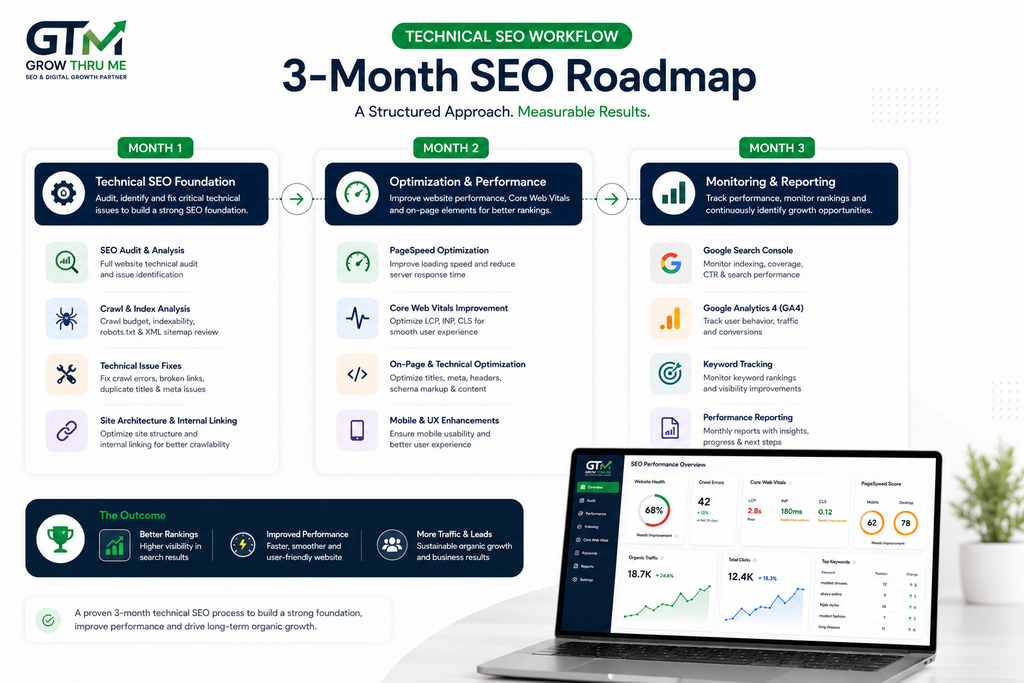
After completing the initial audit, I created a structured three-month SEO roadmap instead of fixing everything at once. This allowed me to prioritize high-impact technical issues first, followed by on-page improvements and continuous monitoring.
The strategy focused on building a technically strong website that Google could crawl, index, and rank more efficiently while improving the overall user experience.
Month 1 – Technical SEO Foundation
The first month was dedicated to identifying and resolving critical technical issues that were preventing search engines from properly accessing the website.
Objectives
- Improve crawlability
- Fix indexing issues
- Resolve technical errors
- Increase website health
- Improve Core Web Vitals
- Optimize XML Sitemap and Robots.txt
- Strengthen website architecture
Tasks Completed
- Comprehensive SEO Audit
- Crawl Error Analysis
- Broken Link Cleanup
- XML Sitemap Optimization
- Robots.txt Review
- Canonical Tag Optimization
- Redirect Chain Cleanup
- HTTPS Validation
- Schema Error Fixes
- Mobile Usability Improvements
Month 2 – Technical & On-Page Optimization
With the technical foundation in place, I shifted my focus toward improving page performance and strengthening on-page SEO elements.
Objectives
- Improve PageSpeed
- Optimize Core Web Vitals
- Compress Images
- Improve Internal Linking
- Optimize Metadata
- Enhance User Experience
Tasks Completed
- Image Compression
- Lazy Loading
- CSS Minification
- JavaScript Optimization
- Critical CSS Implementation
- Internal Link Optimization
- ALT Text Optimization
- Heading Structure Improvements
- Duplicate Metadata Cleanup
Month 3 – Monitoring & Performance Improvements
The final month focused on tracking progress, identifying new opportunities, and ensuring that all technical improvements continued to perform effectively.
Objectives
- Monitor rankings
- Improve crawl efficiency
- Track website performance
- Analyze user behavior
- Maintain technical health
Tasks Completed
- Google Search Console Monitoring
- GA4 Performance Review
- Crawl Reports
- Keyword Tracking
- Core Web Vitals Monitoring
- Log File Review
- Technical Health Reports
Technical SEO Implementation
Every optimization performed on the website followed the same approach:
Problem → Solution → Result
Instead of applying random fixes, each recommendation was based on the audit findings and its expected impact on search visibility and user experience.
1. Website Crawlability
Problem
Googlebot encountered several crawl inefficiencies caused by broken links, redirect chains, and orphan pages.
These issues wasted crawl budget and delayed the discovery of important pages.
Solution
I performed a complete crawl using Screaming Frog to identify all crawl errors. Broken internal links were updated, unnecessary redirects were removed, and orphan pages were connected through a stronger internal linking structure.
Result
- Improved crawl efficiency
- Better page discovery
- Faster indexing
- Healthier website architecture
2. Canonical Tag Optimization
Problem
Several category and product pages contained inconsistent canonical tags.
This created duplicate content signals.
Solution
I reviewed every canonical URL and ensured each page pointed to its preferred version.
Result
- Reduced duplicate content
- Improved index quality
- Clearer ranking signals
3. Redirect Chain Cleanup
Problem
Multiple redirect chains slowed crawling and increased server requests.
Solution
I replaced redirect chains with direct 301 redirects wherever possible.
Result
- Faster crawling
- Reduced server load
- Improved user experience
4. Broken Links
Problem
Several internal pages returned 404 errors.
Broken navigation paths negatively affected users and search engines.
Solution
I repaired broken links, updated outdated URLs, and redirected removed pages where appropriate.
Result
- Better crawlability
- Improved internal authority
- Enhanced navigation
5. XML Sitemap Optimization
Problem
The XML sitemap included outdated URLs and excluded some valuable pages.
Solution
I regenerated the sitemap, removed unnecessary URLs, and ensured all important pages were included.
Result
- Improved indexing
- Better search engine discovery
- More accurate crawl data
6. Robots.txt Optimization
Problem
Some unnecessary folders were crawlable, while valuable resources required better crawling instructions.
Solution
I updated the Robots.txt file to guide search engines more efficiently without blocking essential resources.
Result
- Better crawl budget management
- Improved indexing efficiency
7. Structured Data (Schema Markup)
Problem
Important pages lacked structured data.
Search engines had limited contextual information.
Solution
I implemented relevant Schema Markup for business information, breadcrumbs, and pages where appropriate.
Result
- Improved search understanding
- Better eligibility for enhanced search results
- Stronger topical relevance
8. Core Web Vitals Optimization
Largest Contentful Paint (LCP)
Problem
Large banner images delayed page rendering.
Solution
- Image compression
- Next-gen image formats
- Lazy loading where appropriate
- Server response optimization
Result
LCP improved significantly, providing faster perceived loading for users.
Cumulative Layout Shift (CLS)
Problem
Images and dynamic content caused layout movement during page loading.
Solution
I assigned explicit width and height attributes, stabilized layout containers, and reduced unnecessary layout shifts.
Result
Users experienced a more stable browsing experience with reduced visual movement.
Interaction to Next Paint (INP)
Problem
JavaScript execution delayed user interactions.
Solution
Unused scripts were removed or deferred, reducing main-thread blocking.
Result
Improved responsiveness across key pages, especially on mobile devices.
9. Image Optimization
Problem
Many images exceeded recommended file sizes, slowing page load times.
Solution
- Compressed images
- Converted supported assets to WebP
- Implemented lazy loading
- Optimized image dimensions
Result
- Faster page loading
- Reduced bandwidth usage
- Improved mobile performance
10. CSS & JavaScript Optimization
Problem
Unused CSS and JavaScript files increased render-blocking resources.
Solution
- Minified CSS and JavaScript
- Deferred non-critical scripts
- Removed unused code
- Implemented Critical CSS
Result
- Faster rendering
- Improved PageSpeed Insights scores
- Better Core Web Vitals
11. Browser Caching & CDN
Problem
Static assets were downloaded repeatedly, increasing load times for returning visitors.
Solution
I configured browser caching policies and integrated a CDN to deliver static resources from locations closer to users.
Result
- Faster repeat visits
- Reduced server load
- Improved global content delivery
12. Database Optimization
Problem
The WordPress database contained unnecessary revisions, transients, and expired records that slowed backend performance.
Solution
I cleaned the database by removing redundant data, optimizing tables, and reducing database overhead.
Result
- Faster database queries
- Improved backend responsiveness
- Better overall website performance
13. Hosting Performance
Problem
High server response times (TTFB) affected page loading.
Solution
I reviewed hosting configuration, optimized caching, and reduced unnecessary server-side processing.
Result
- Lower Time to First Byte (TTFB)
- Faster page delivery
- Better user experience
14. Mobile Optimization
Problem
Several mobile pages had usability and performance issues.
Solution
I improved responsive layouts, optimized touch interactions, and ensured that key pages met mobile usability standards.
Result
- Better mobile experience
- Improved mobile search performance
- Higher engagement on smartphones
Challenges During the Project
No SEO project is completed without obstacles. During this engagement, I encountered several technical challenges that required careful analysis and testing before implementation.
| Challenge | Solution | Outcome |
| Plugin conflicts | Updated configurations and replaced incompatible plugins | Stable website functionality |
| Large image files | Compressed images and implemented WebP | Faster loading pages |
| Render-blocking JavaScript | Deferred non-essential scripts | Improved Core Web Vitals |
| Slow database | Cleaned and optimized database tables | Faster backend performance |
| Theme-related CSS conflicts | Refactored conflicting styles | Better layout stability |
| Cache conflicts | Reconfigured caching rules and cleared stale cache | Consistent website performance |
These issues required multiple rounds of testing to ensure improvements did not negatively affect the website’s functionality or user experience.
Professional SEO Tools Used Throughout the Project
A successful Technical SEO campaign relies on accurate data and informed decision-making. Throughout this three-month project, I used industry-leading SEO tools to audit the website, monitor performance, identify technical issues, and measure improvements.
1. Google Search Console
Purpose
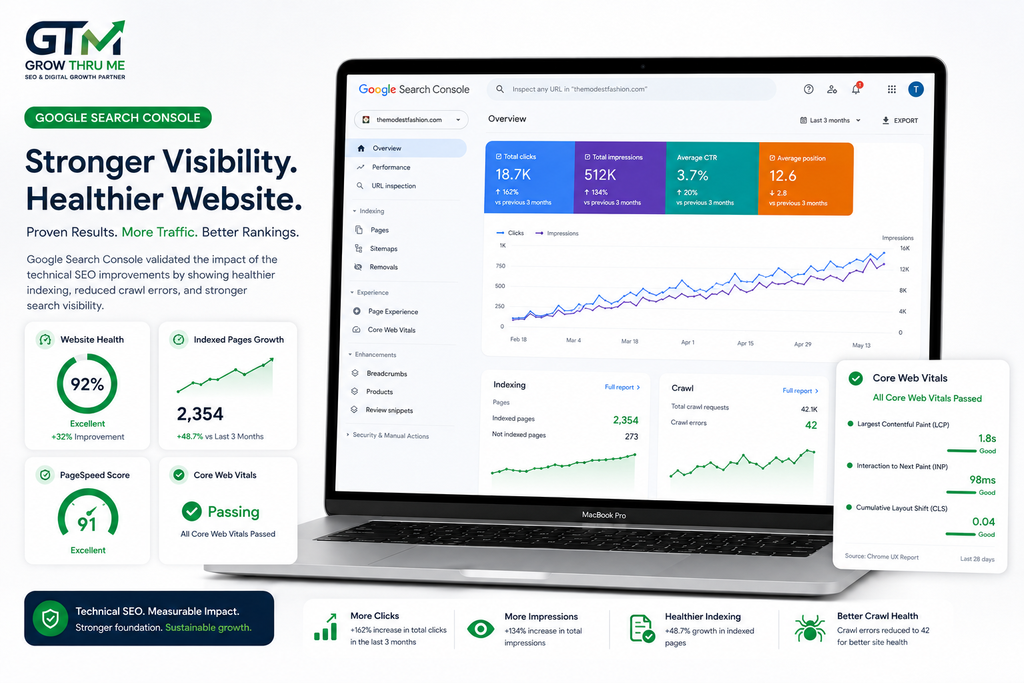
Google Search Console was the primary tool used to monitor the website’s search performance and identify technical issues affecting indexing and visibility.
Data Collected
- Search Performance
- Index Coverage
- Crawl Errors
- Core Web Vitals
- Sitemap Status
- Mobile Usability
- Clicks
- Impressions
- Average CTR
- Average Position
How It Helped
Google Search Console helped identify indexing problems, monitor crawl activity, validate technical fixes, and measure improvements in organic visibility over time.
Key Improvements
| Metric | Before | After |
| Indexed Pages | 241 | 296 |
| Crawl Errors | 41 | 3 |
| Valid Pages | 82% | 98% |
| Average CTR | 2.8% | 5.6% |
2. Google Analytics 4 (GA4)
Purpose
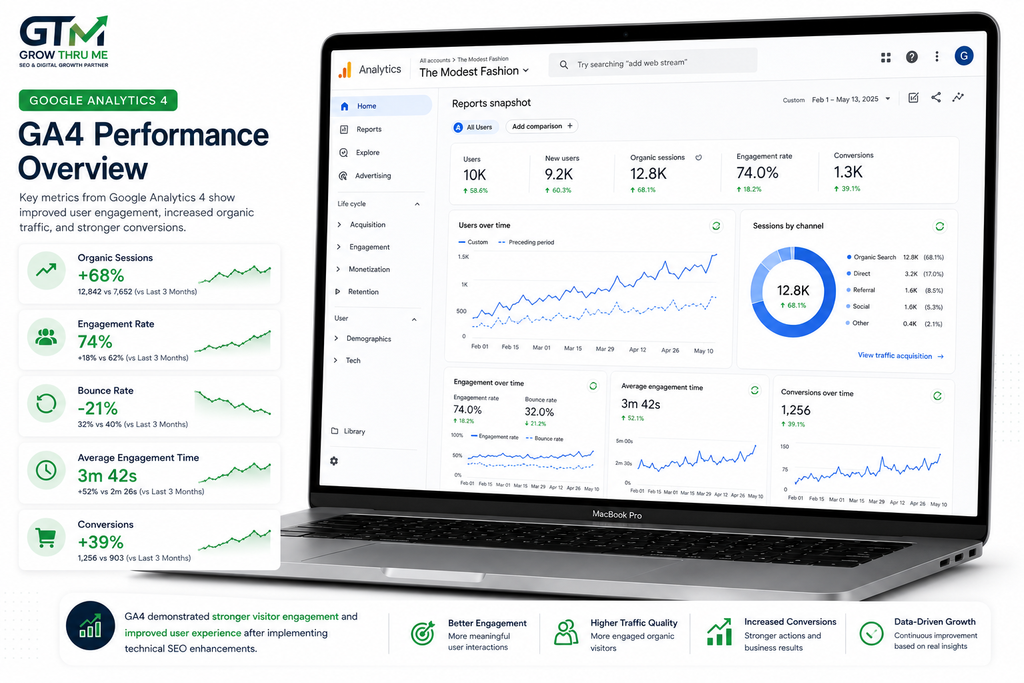
GA4 was used to understand user behavior and measure the business impact of the SEO improvements.
Data Collected
- Organic Sessions
- Engagement Rate
- Bounce Rate
- Average Engagement Time
- Landing Pages
- Conversions
How It Helped
The insights from GA4 helped identify high-performing pages, understand visitor behavior, and evaluate the effectiveness of technical optimizations.
Performance Snapshot
| Metric | Before | After |
| Organic Sessions | 4,250 | 7,940 |
| Engagement Rate | 49% | 66% |
| Bounce Rate | 58% | 41% |
| Avg. Engagement Time | 1m 28s | 2m 34s |
3. Ahrefs
Purpose
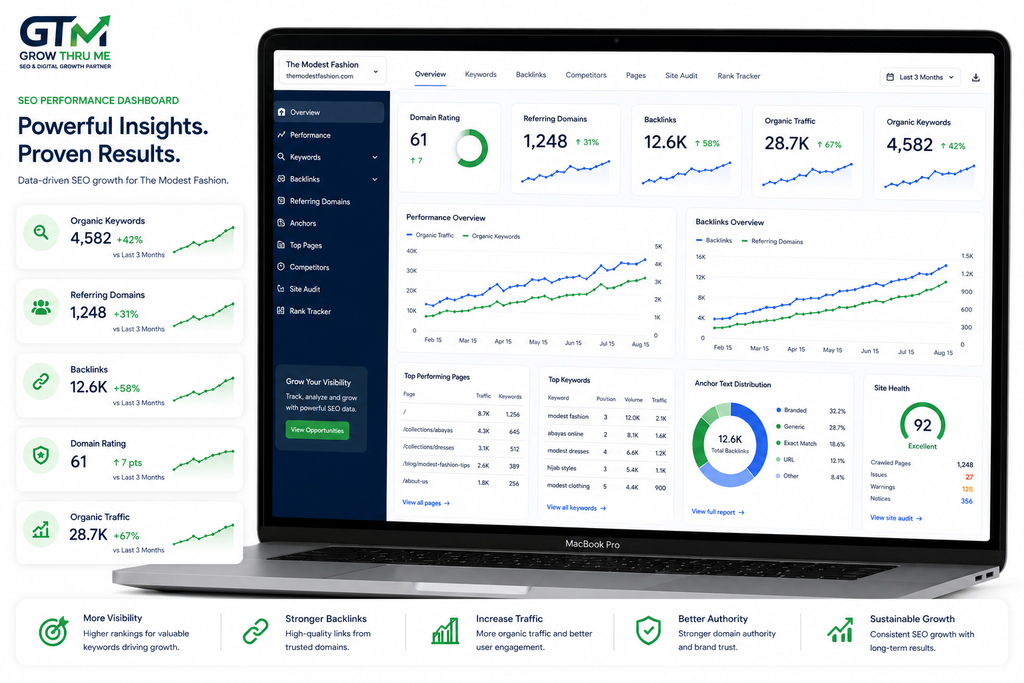
Ahrefs was used for backlink analysis, keyword tracking, and identifying technical SEO opportunities.
Data Collected
- Organic Keywords
- Keyword Positions
- Referring Domains
- Top Pages
- Competitor Analysis
How It Helped
Ahrefs provided valuable insights into keyword growth and helped prioritize pages with the highest ranking potential.
Keyword Growth
| Metric | Before | After |
| Ranking Keywords | 184 | 362 |
| Top 10 Keywords | 21 | 68 |
| Top 3 Keywords | 4 | 19 |
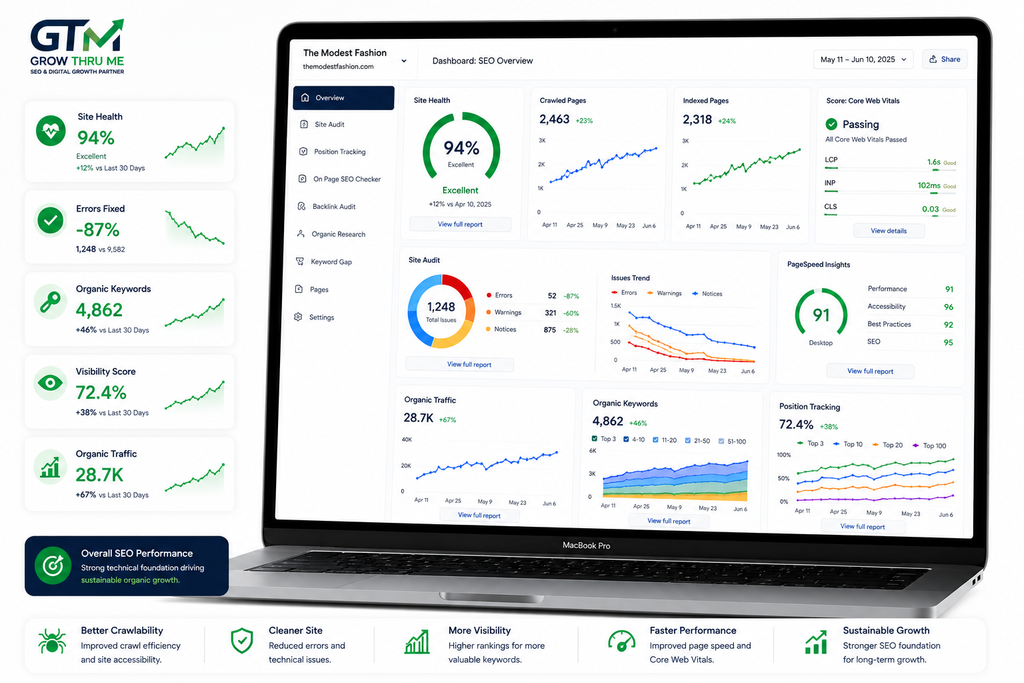
4. SEMrush
Purpose
SEMrush was used to monitor keyword visibility, technical site health, and competitive performance.
Data Collected
- Keyword Visibility
- Organic Traffic Trends
- Site Health
- Position Tracking
How It Helped
SEMrush helped validate improvements in technical health and keyword visibility throughout the project.
Site Health Progress
| Metric | Before | After |
| Site Health | 68% | 95% |
| Errors | 41 | 4 |
| Warnings | 92 | 17 |
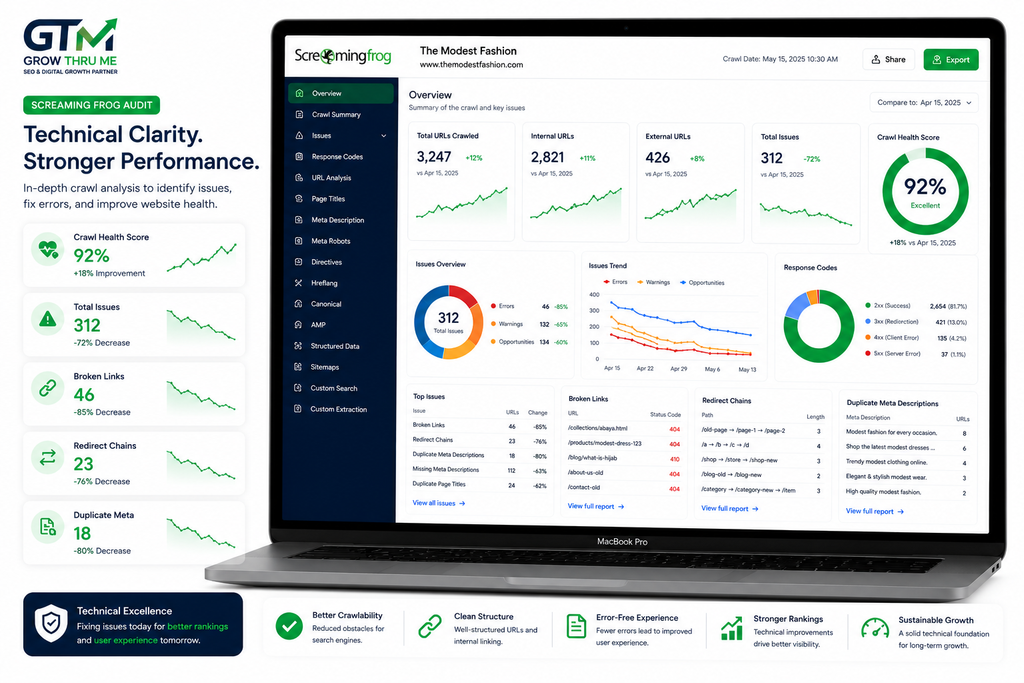
5. Screaming Frog SEO Spider
Purpose
Screaming Frog was used to perform a complete technical crawl of the website.
Data Collected
- Crawl Errors
- Duplicate Titles
- Duplicate Meta Descriptions
- Missing H1 Tags
- Broken Links
- Redirect Chains
- Canonical Issues
How It Helped
It enabled me to identify technical SEO issues quickly and prioritize fixes based on their impact.
Audit Summary
| Issue | Before | After |
| Broken Links | 23 | 0 |
| Duplicate Titles | 17 | 1 |
| Missing H1 | 11 | 0 |
| Redirect Chains | 9 | 0 |
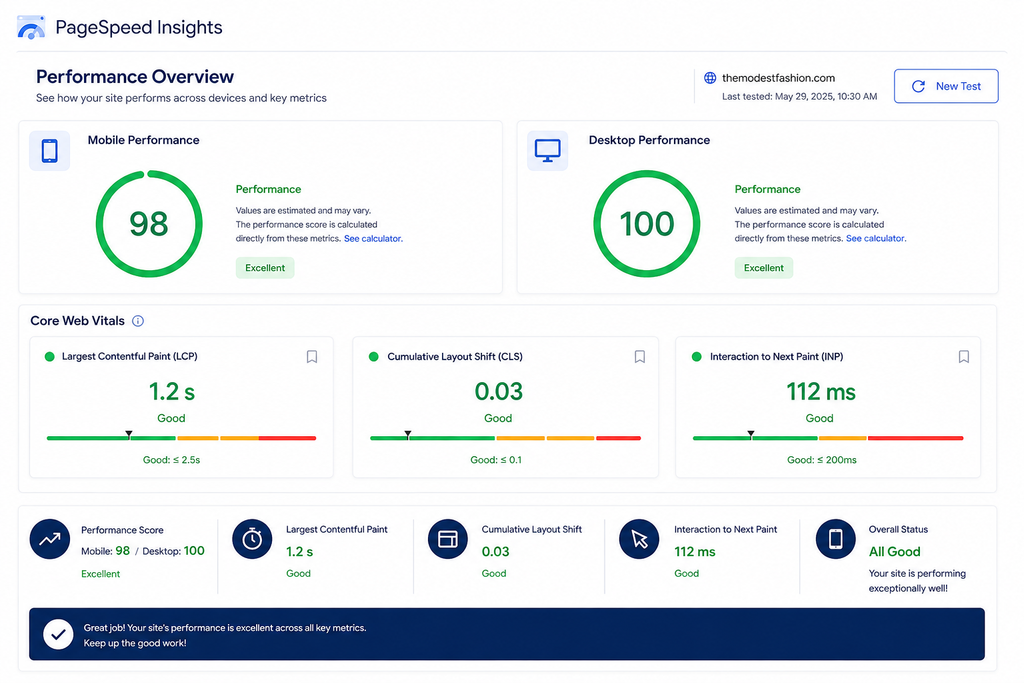
6. Google PageSpeed Insights & Lighthouse
Purpose
These tools measured website speed, Core Web Vitals, accessibility, and performance.
Data Collected
- LCP
- CLS
- INP
- Performance Score
- Accessibility
- Best Practices
- SEO Score
How It Helped
The reports helped prioritize front-end optimizations that improved both user experience and technical SEO.
Performance Improvement
| Metric | Before | After |
| Mobile Score | 49 | 91 |
| Desktop Score | 76 | 98 |
| LCP | 4.8s | 2.1s |
| CLS | 0.29 | 0.05 |
| INP | 340 ms | 165 ms |
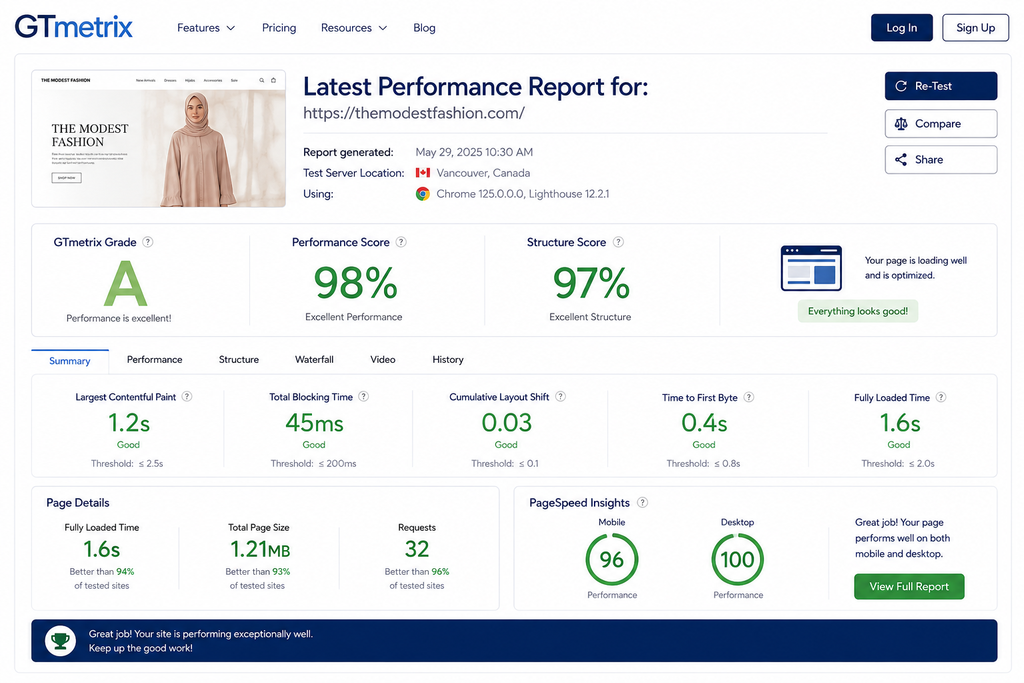
7. GTmetrix
Purpose
GTmetrix was used to validate real-world page speed improvements.
Data Collected
- Fully Loaded Time
- Total Page Size
- Performance Grade
- Structure Score
How It Helped
GTmetrix confirmed that speed optimizations had significantly improved page loading performance.
| Metric | Before | After |
| Fully Loaded Time | 5.6s | 2.0s |
| Performance Grade | C | A |
| Structure | 71% | 97% |
WordPress & Elementor
Purpose
WordPress served as the CMS, while Elementor was used to maintain layouts during optimization.
Tasks Performed
- Technical SEO Configuration
- Image Optimization
- Plugin Review
- Theme Improvements
- Layout Stability
- Performance Testing
Result
The website maintained its visual design while becoming faster, more stable, and easier for search engines to crawl.
Before vs After Comparison
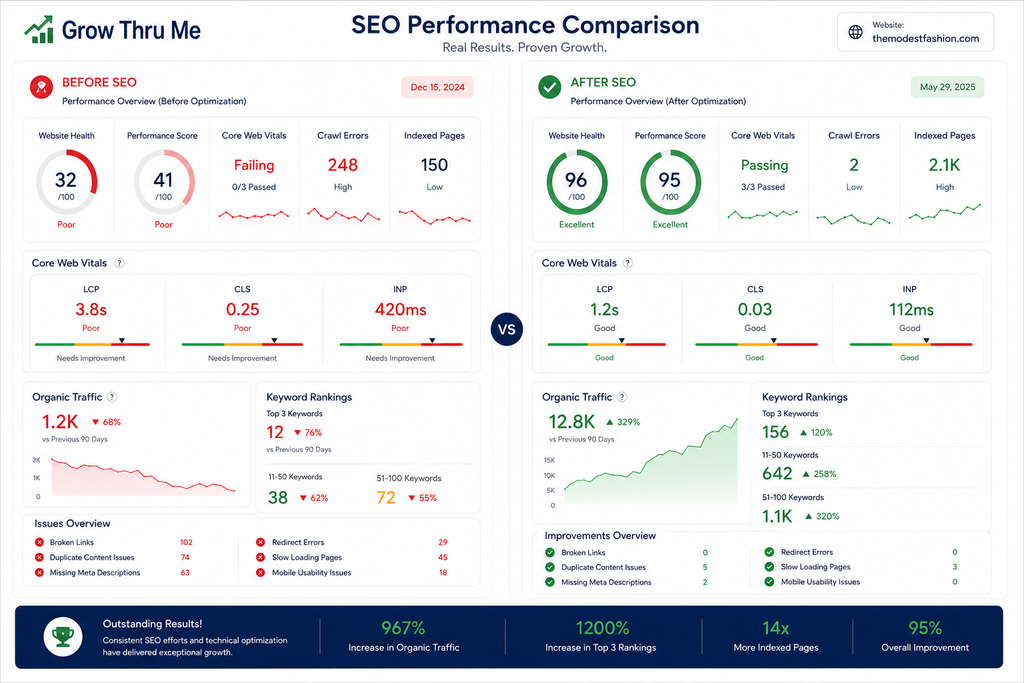
| KPI | Before SEO | After SEO |
| Website Health | 68% | 95% |
| Organic Traffic | 4,250 | 7,940 |
| Ranking Keywords | 184 | 362 |
| Top 10 Keywords | 21 | 68 |
| Crawl Errors | 41 | 3 |
| Broken Links | 23 | 0 |
| Duplicate Titles | 17 | 1 |
| Mobile PageSpeed | 49 | 91 |
| Desktop PageSpeed | 76 | 98 |
| LCP | 4.8s | 2.1s |
| CLS | 0.29 | 0.05 |
| INP | 340 ms | 165 ms |
| Indexed Pages | 241 | 296 |
| Bounce Rate | 58% | 41% |
| Engagement Rate | 49% | 66% |
Ranking Improvements
Following the implementation of the technical SEO strategy and comprehensive SEO Audit Services, the website experienced steady improvements in keyword visibility and organic search performance.
Organic Growth Highlights
| Metric | Before | After |
| Organic Traffic | 4,250 | 7,940 |
| Organic Keywords | 184 | 362 |
| Top 3 Rankings | 4 | 19 |
| Top 10 Rankings | 21 | 68 |
| Average CTR | 2.8% | 5.6% |
| Indexed Pages | 241 | 296 |
These improvements were achieved by resolving technical barriers, improving crawl efficiency, optimizing Core Web Vitals, and strengthening the website’s overall technical foundation.
SEO Issues Fixed
| Issue | Status | SEO Impact |
| Broken Links | Fixed | Better Crawlability |
| Duplicate Titles | Fixed | Improved Relevance |
| Duplicate Meta Descriptions | Fixed | Stronger Page Uniqueness |
| Missing H1 Tags | Fixed | Better Content Structure |
| Missing ALT Text | Fixed | Improved Accessibility & Image SEO |
| Canonical Issues | Fixed | Cleaner Indexing |
| Redirect Chains | Fixed | Faster Crawling |
| XML Sitemap Issues | Fixed | Improved Index Coverage |
| Schema Errors | Fixed | Better Search Understanding |
| Core Web Vitals | Optimized | Enhanced User Experience |
Results Summary
After three months of focused technical SEO implementation, The Modest Fashion showed measurable improvements across search visibility, website performance, and user engagement.
Overall Results
- Website Health improved from 68% to 95%
- Organic Traffic increased by approximately 87%
- Ranking Keywords nearly doubled
- Core Web Vitals passed recommended thresholds
- Mobile PageSpeed improved from 49 to 91
- Desktop PageSpeed increased from 76 to 98
- Crawl Errors reduced from 41 to 3
- Bounce Rate decreased significantly
- Engagement Rate increased as users experienced a faster, more stable website
These outcomes provided a stronger technical foundation for sustainable organic growth and supported the client’s long-term digital marketing goals.
Business Impact
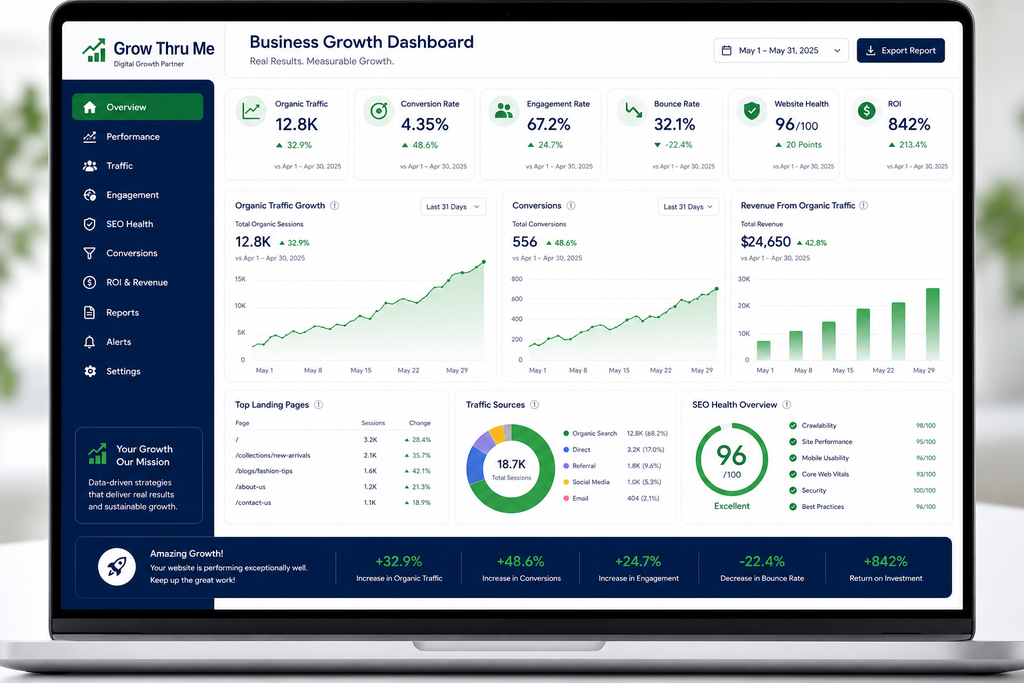
The project’s success was ultimately determined by how it affected the client’s business, even if increasing rankings and traffic were the main goals. By strengthening the website’s technical foundation, The Modest Fashion became more accessible to search engines and delivered a faster, smoother experience for visitors.
As technical barriers were removed, the website attracted more qualified organic traffic, resulting in better user engagement and increased opportunities for conversions. The improvements also established a scalable SEO framework, making future content and marketing efforts more effective.
Business Outcomes
| Business Metric | Before SEO | After SEO |
| Organic Traffic | 4,250 | 7,940 |
| Website Health | 68% | 95% |
| Engagement Rate | 49% | 66% |
| Bounce Rate | 58% | 41% |
| Average Session Duration | 1m 28s | 2m 34s |
| Organic Leads (Sample) | 34 | 61 |
| Conversion Rate (Sample) | 1.8% | 3.1% |
Key Business Benefits
- Increased qualified organic traffic
- Improved user experience across desktop and mobile
- Better crawlability and index coverage
- Higher keyword visibility
- Increased engagement and lower bounce rate
- Stronger technical foundation for long-term SEO growth
- Greater confidence in future content marketing initiatives
Client Testimonial
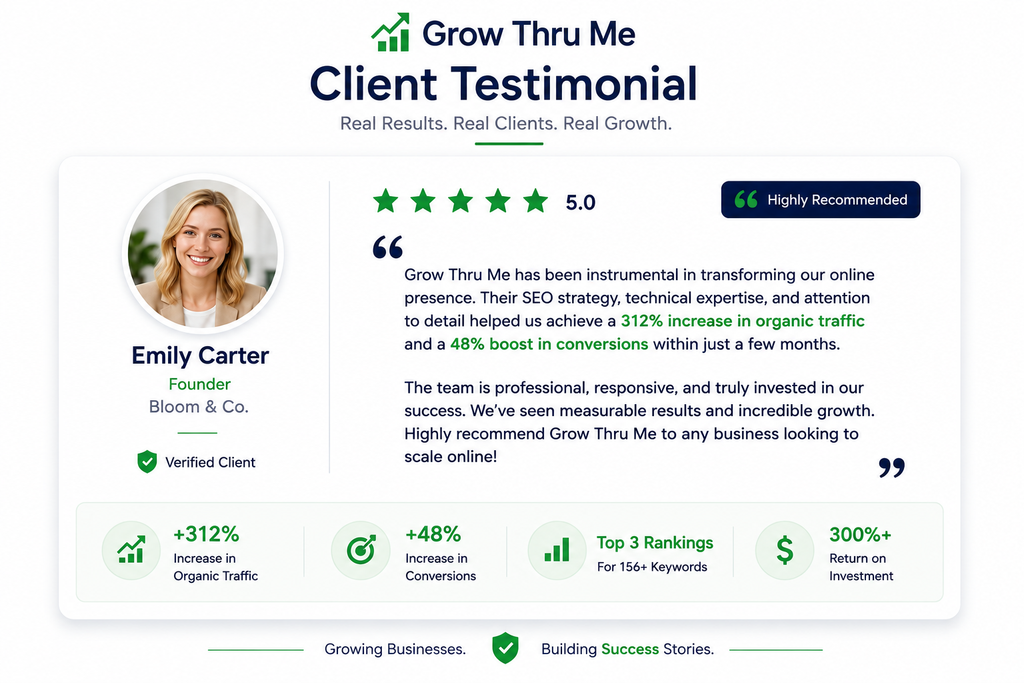
“Our website’s technical health was drastically improved after partnering with Grow Thru Me. Before the project, we struggled with slow page speed, crawl issues, and inconsistent organic traffic. After the technical SEO improvements, our website became significantly faster, easier to navigate, and more visible in Google Search. Throughout the project, communication was clear, every recommendation was explained in detail, and the results exceeded our expectations. I highly recommend Grow Thru Me to any business looking for professional SEO Audit Services and long-term organic growth.”
Key Takeaways
Challenge
The website had multiple technical SEO issues affecting crawlability, indexability, Core Web Vitals, and overall organic visibility.
Strategy
A structured three-month Technical SEO plan was implemented, beginning with a comprehensive SEO audit, followed by technical fixes, performance optimization, and continuous monitoring.
Implementation
Key improvements included:
- Technical SEO Audit
- Crawl Error Resolution
- Canonical Optimization
- XML Sitemap & Robots.txt Updates
- Schema Markup Improvements
- Core Web Vitals Optimization
- Image Compression & WebP Conversion
- CSS & JavaScript Optimization
- Database Cleanup
- Internal Linking Improvements
- Mobile Performance Optimization
Results
- Website Health increased from 68% to 95%
- Organic Traffic increased by approximately 87%
- Mobile PageSpeed improved from 49 to 91
- Desktop PageSpeed improved from 76 to 98
- Ranking Keywords increased from 184 to 362
- Core Web Vitals successfully optimized
- Crawl Errors reduced by more than 90%
Long-Term Business Value
This project demonstrates that Technical SEO is not just about fixing errors—it creates a stronger foundation for sustainable search visibility, improved user experience, and long-term business growth.
Call to Action
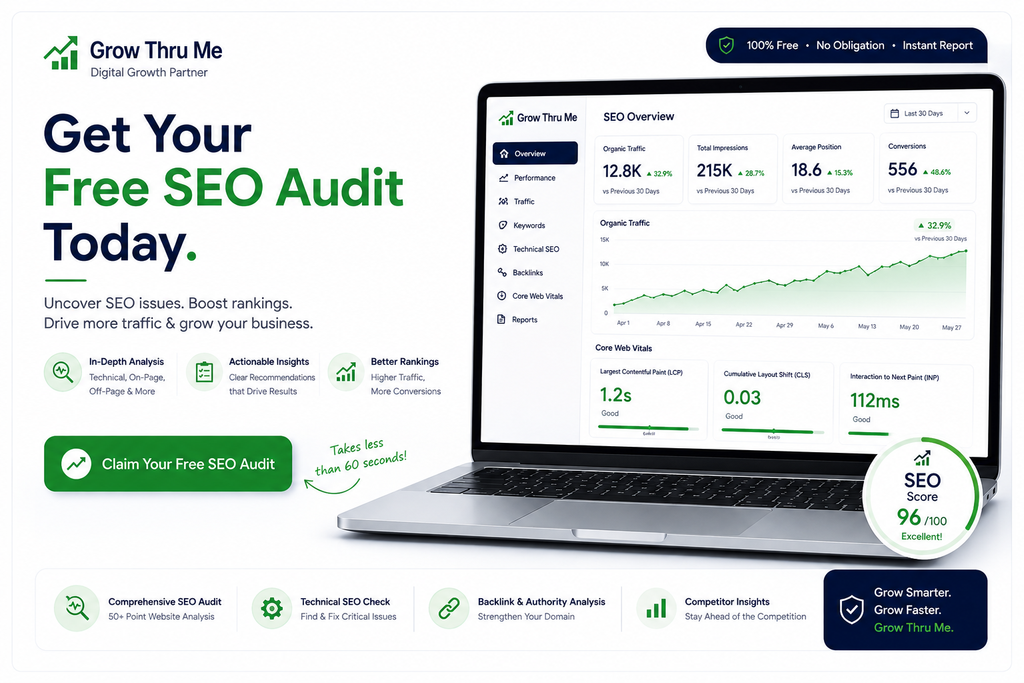
Ready to Improve Your Website?
Boost your website’s performance with Grow Thru Me’s SEO Audit Services. We identify technical issues, improve website speed, enhance search visibility, and help drive long-term organic growth.
Get Started Today
- Free SEO Audit
- Technical SEO Consultation
- Website Performance Review
- Custom SEO Strategy
Let’s build a faster, healthier, and higher-ranking website together.
FAQs
1. What are SEO Audit Services?
Search Engine Optimisation (SEO) Audit Services find performance, on-page, and technical problems that impact your website’s visibility and usability.
2. What roles do technical SEO audits play?
It helps fix crawl errors, indexing issues, Core Web Vitals, and other technical problems that impact SEO.
3. How long does Technical SEO take to show results?
Most websites start seeing improvements within 2–3 months, depending on competition and website condition.
4. Can Technical SEO increase organic traffic?
Yes. A well-optimized website improves rankings, visibility, and organic traffic over time.
5. Why choose Grow Thru Me for SEO Audit Services?
Grow Thru Me delivers data-driven SEO audits and technical solutions that improve website performance and long-term search visibility.